Two attractions,
rebuilt in the game's language
For the Unity mobile game Theme Park Manager, we built two 16-seat tower attractions with UModeler X — Gyro Drop and X-Flyer. The first version showed us exactly where they had to meet the park's existing look, and they were rebuilt around its camera, proportions and material language. The game team then added the ride animation and colour work, and both rides took their place in the live game.
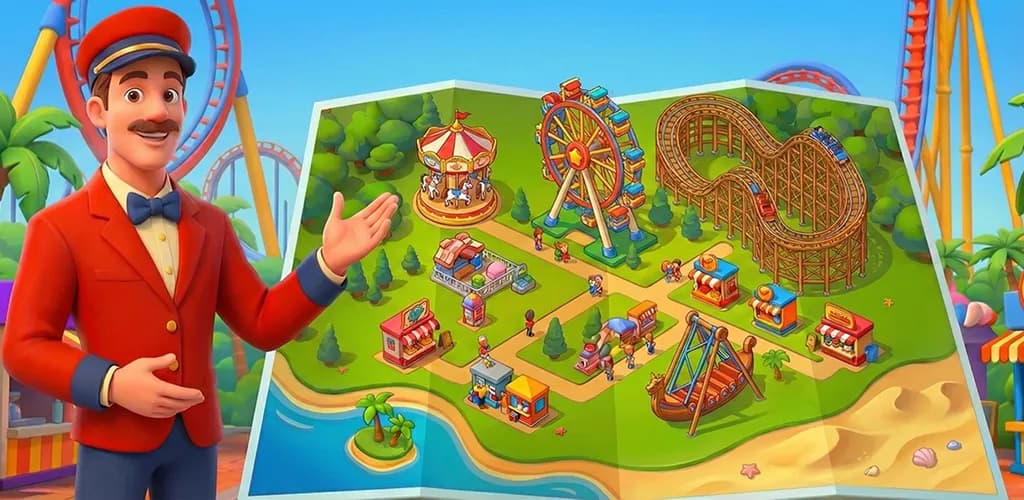
Hyper-casual to play, realistic to look at
When Albus, the studio behind Theme Park Manager, contacted the UModeler X team in July 2025, they came with a specific problem. Their new title is a park-management simulation. The loop is hyper-casual — direct and repeatable — but the visuals deliberately aim at a realistic look. Players responded best when a ride felt big, so the art team was pushing scale and mechanical detail across every attraction.
To widen the line-up they needed two tower rides: a Gyro Drop and an X-Flyer, 16 seats each. The reference that came with the request wasn't concept art — it was photographs of real amusement-park towers, plus screenshots of the rides already standing in their park.
That second set mattered more than it looked. A new attraction is never judged on its own. It is judged standing next to the rides already there, under the same camera, in the same light.
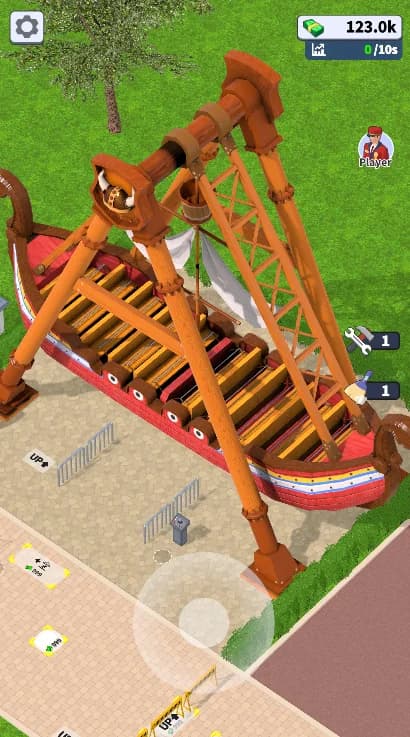
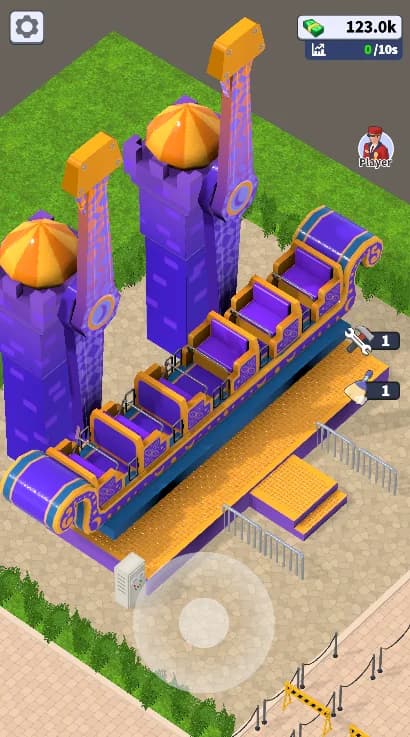
The two rides Albus sent as "the art direction to match" — already standing in the game. Grounded proportions, mechanical structure on show, individual seats clearly readable — and a camera that always looks down at the park diagonally. Screenshots courtesy of Albus.
The first version showed us what to match
Both rides were modeled with UModeler X inside the Unity Editor and shared with the game team on July 23, 2025 — as prefabs that drop straight into a project with UModeler X installed. Texturing used a simple palette approach, and we set out the alternative alongside it: if a more photoreal treatment was wanted, the meshes could be re-unwrapped and the textures swapped.
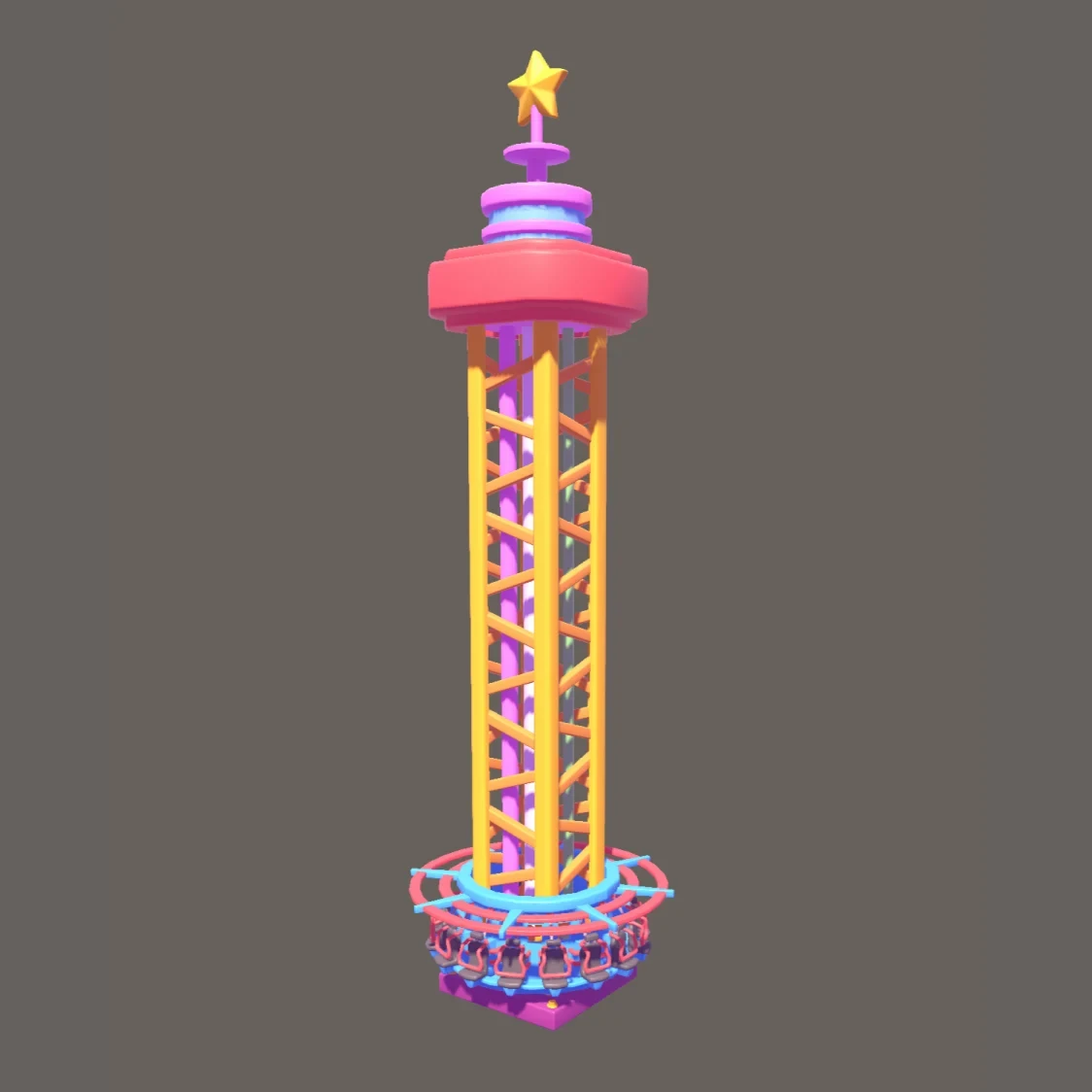
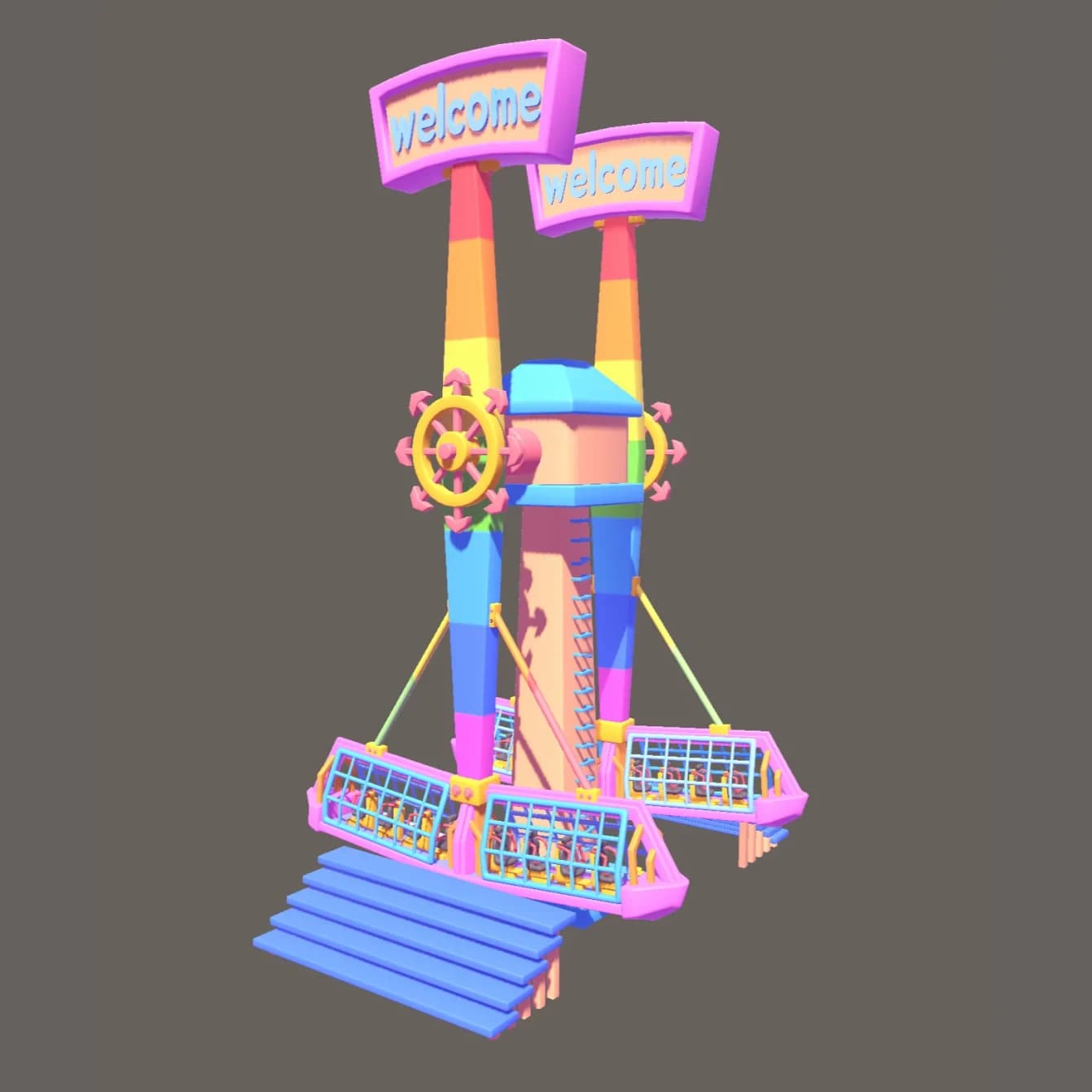
These are lovely, but the style sits a long way from ours, so using them as they are would be difficult. A ride that looks like a real machine is the core of this game. Adjusting them on our side wouldn't be straightforward either — could you rework them using our own rides as the reference?
Albus · feedback on the first version, July 23, 2025 (paraphrased)
Nothing about that first version fell short technically. The geometry was clean, the prefabs worked, and the rides functioned as rides. But to become this park's attractions, they had to read correctly inside the same camera, lighting and proportions as everything already standing there. Style is not a detail you patch at the end. On a game whose whole appeal is the spectacle of a convincing ride, style is the specification.
Four constraints, all of them physical
The day after the feedback, what Albus sent was not a critique but a concrete production standard — along with the source files they use in their own park. The intent was clear: align the two working environments rather than guess at them.
- Seated guests must stay visibleThe game view looks down at the park diagonally, so anything wrapping around or hiding the seats had to go. Players need to see that people are riding.
- Under 10,000 vertices per modelA fixed budget for mobile. Detail had to come from silhouette and texture, not from polygons.
- X-Flyer down to 0.7× heightGyro Drop's scale was fine as it was. Testing showed the X-Flyer worked best at about seven-tenths of its height — that's what made the two towers read as a matched pair in the skyline.
- Belong to the park that existsAlbus shared the reference assets and screenshots they use in the game. Placed beside those, the new rides had to not look imported.
One more thing was confirmed before modeling restarted: the Unity version and render pipeline. The answer — Unity 2022.3.19f1 with URP, the combination used across every project at the studio — decided how the materials would be authored.
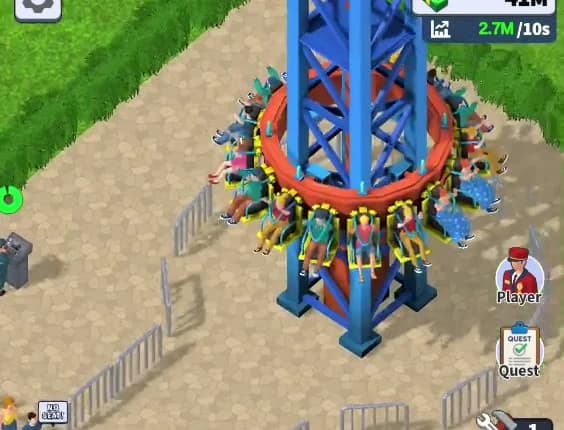
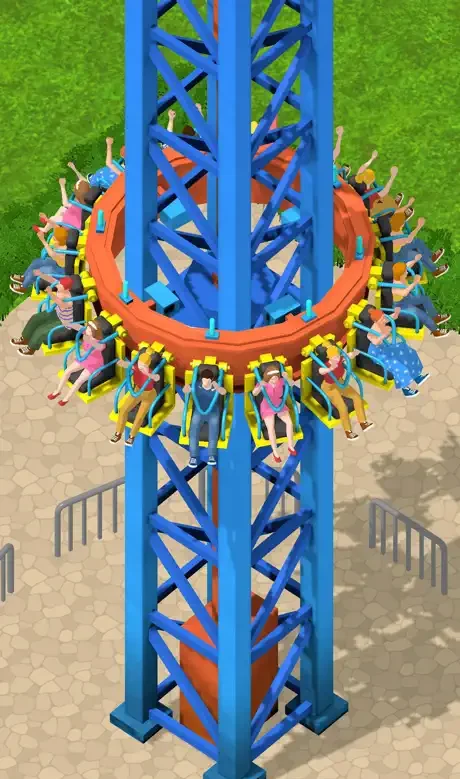
Why the seating rule exists. Under the game's camera this ring of riders is the whole ride — sixteen separate passengers, restraints down, legs hanging. Cover that and the attraction stops explaining itself.
The same rides, remade in Theme Park's language
Six days after the feedback, on July 29, 2025, both rides came back as new versions built to the park's language: industrial steel lattice, grounded proportions, mechanical hardware on show, and seating exposed on purpose.
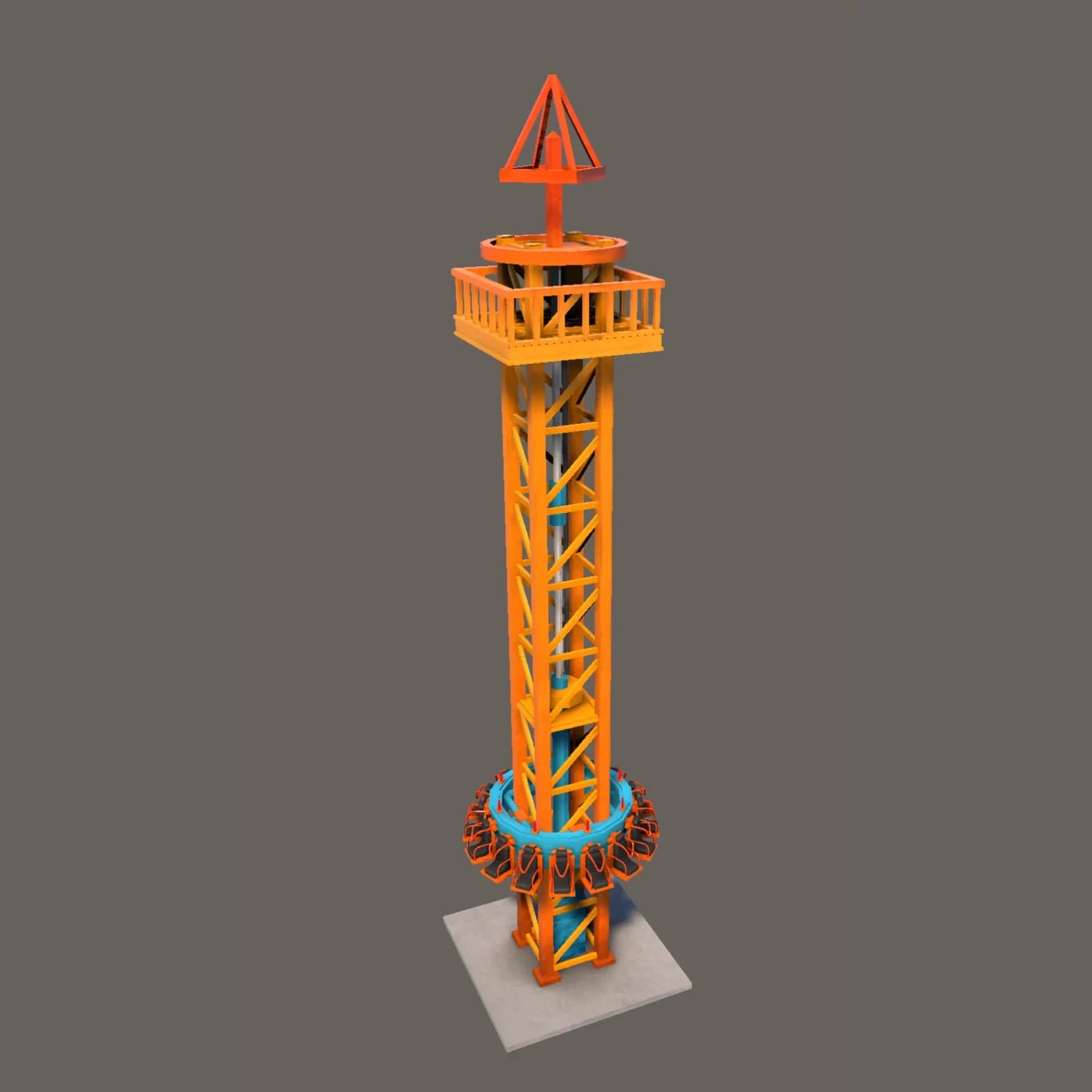
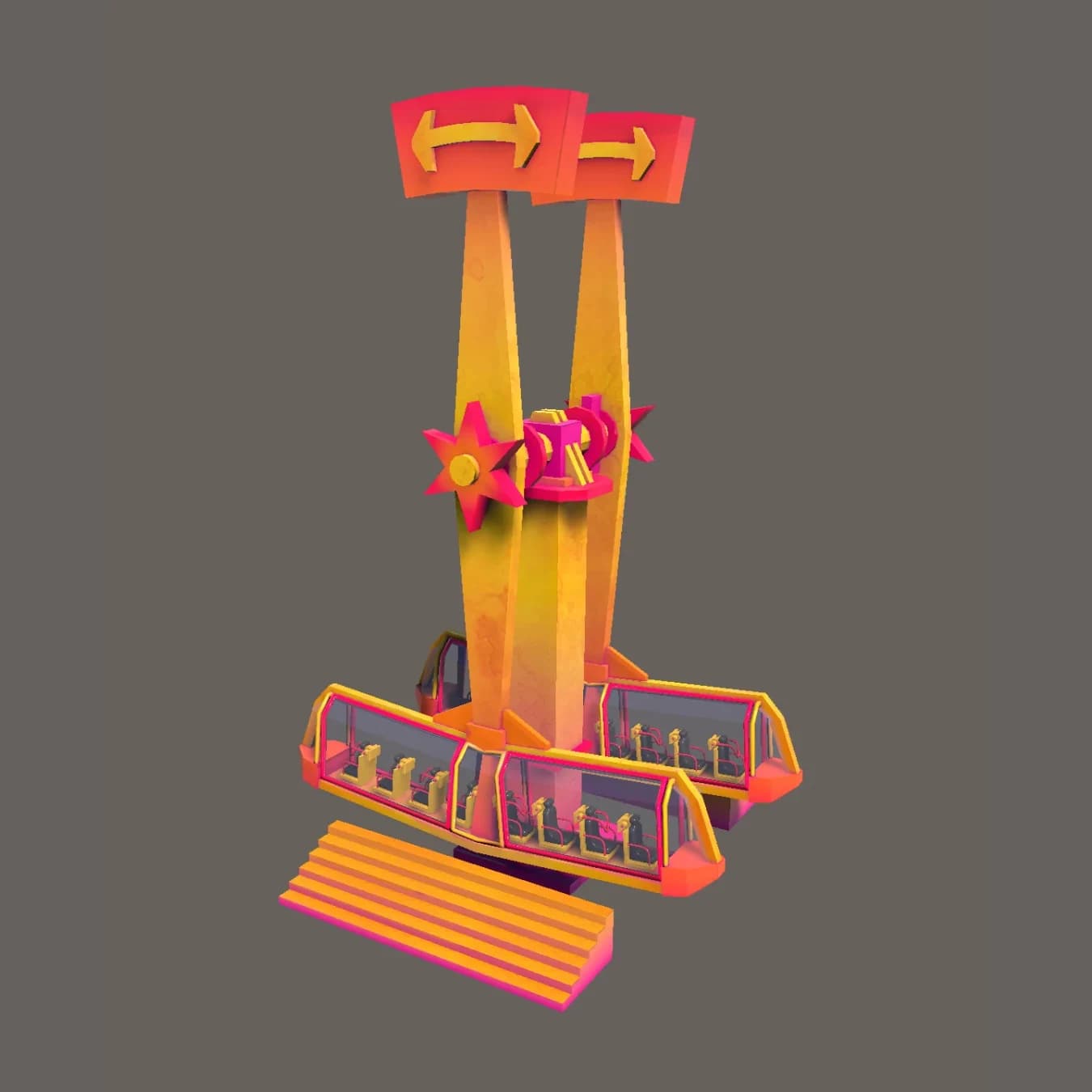
Checked them over — this time they should sit well with our game's look. We'll take them through animation and some colour adjustment before putting them in.
Albus · on the second version, July 29, 2025 (paraphrased)
It's worth looking closely at what changed and what didn't. The function survived intact — sixteen seats, a drop tower and a pendulum swing, the same footprint logic. What was rebuilt was the language: toy silhouettes became structure, flat candy colour became painted steel, decorative signage became mechanical hardware. That is a far bigger change than it sounds, and it landed inside a week.
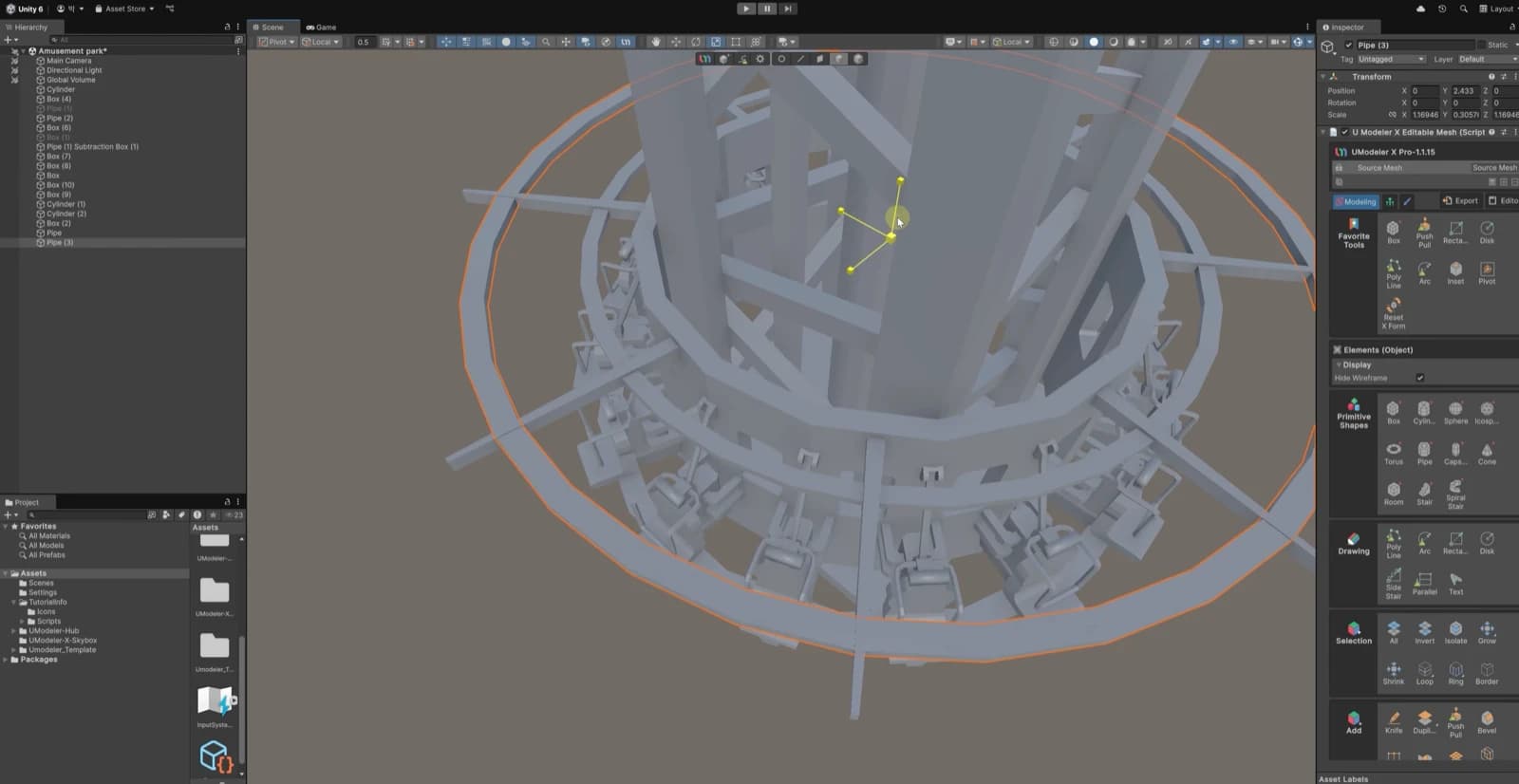
Editing the drop tower's structure inside Unity
Working views of the Gyro Drop — editing the seat ring and structure with UModeler X, and arraying its radial elements.
Editing the drop tower's seat ring and structure in UModeler X.
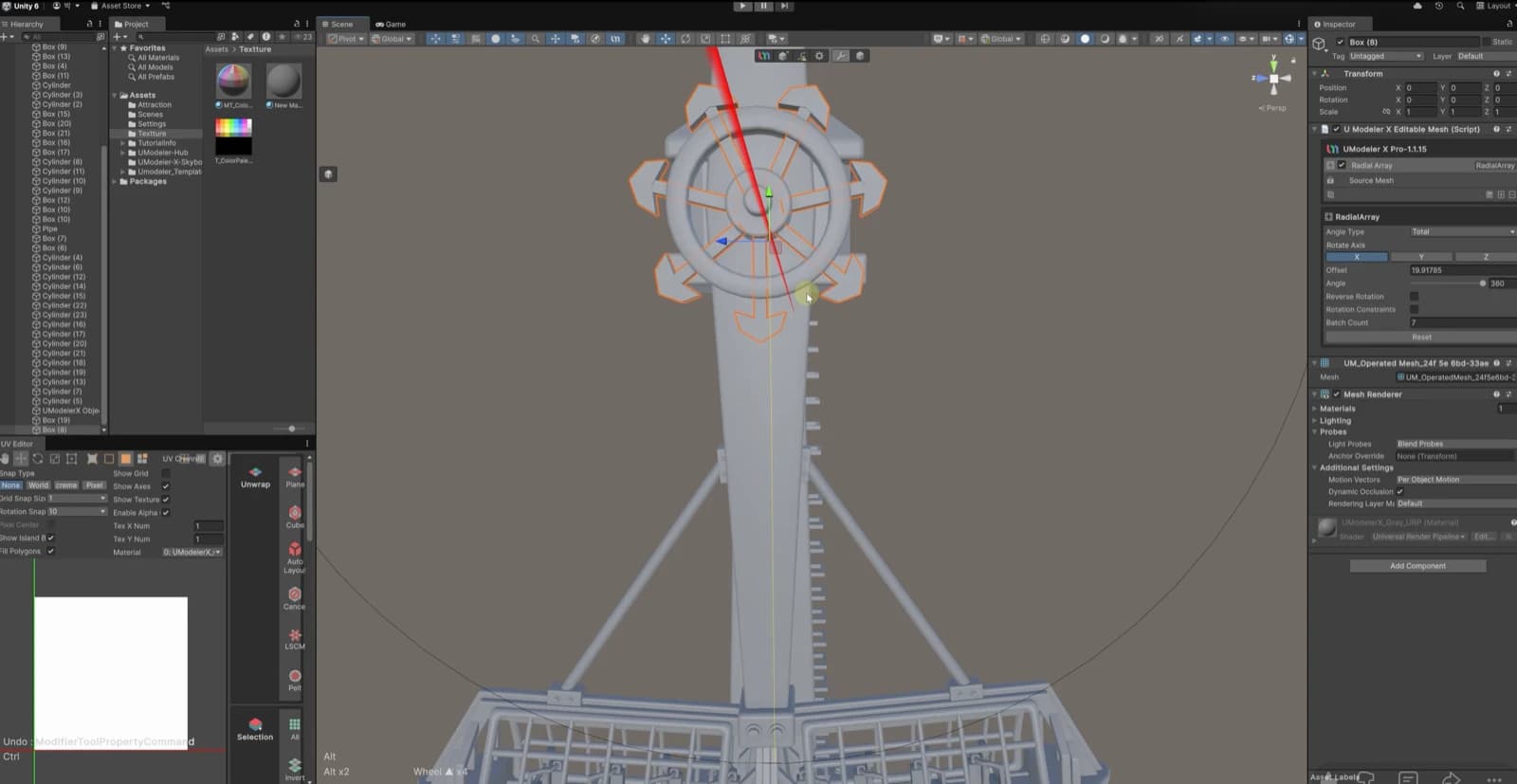
Radial Array — arraying the ride's radial elements in UModeler X.
The assets we received from UModeler X arrived in a state we could edit directly inside our Unity project, so adjusting them to our game's look went quickly.
Byungju Son · CEO, Albus
Why the direction could be realigned that fast
Nothing here was automatic. What made the schedule possible is that the models never once left the environment they would ultimately be judged in.
Modeled inside Unity
UModeler X runs in the Unity Editor. The rides were built in the very project, pipeline and camera that would judge them — not built elsewhere and exported in.
Refined together as editable prefabs
Shared as editable Unity-native assets rather than baked meshes. Height, proportion and structure stayed adjustable inside the project throughout production.
Texturing that could be swapped
The first pass used a lightweight palette approach; the second moved to Substance Painter. Those source files were handed over too, so Albus could keep tuning the look themselves.
The game team finished it
Albus added the ride animation, adjusted colours to the park's palette, and integrated both attractions into the live build.
The point was never about discarding the first version. When you realign the production standard inside the same game environment and keep the asset editable, a change of direction costs days rather than a restart.
Sixteen seats, forty seconds, one live park
On August 19, 2025 — while the game was still in development — Albus sent footage of the tower running in the build. Recoloured to the park's blue, animated, loading guests.
The model we built together, moving in the game
The lattice mast, the observation deck and beacon, the seat ring at the base — the same structure that was rebuilt to the game look in July. Repainted blue for the park, with animation added by the Albus team. Guests queue at the rail, ride, and clear out.
- 0:00 Park path — the player walks toward the tower base (“Clean rides 3 times” quest on screen)
- 0:04 The Drop Tower panel opens: 1M per 10 s · 16 seats · 40 s ride; the gondola ring sits at the top
- 0:08 The ring drops down the lattice with riders aboard
- 0:12 The ring reaches the bottom and starts back up
- 0:16 Back to the park view — guests queue at the ride entrance
The detail worth pausing on is the stats panel. 16 seats and a 40-second cycle aren't art-direction language — they're this ride's live game data. The seat count written into the first request back in July survived two rounds of production and the game team's integration, and is still the value this ride runs on.
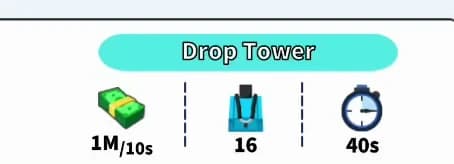
The Drop Tower's live stat line in Theme Park Manager — capacity 16, ride time 40s.
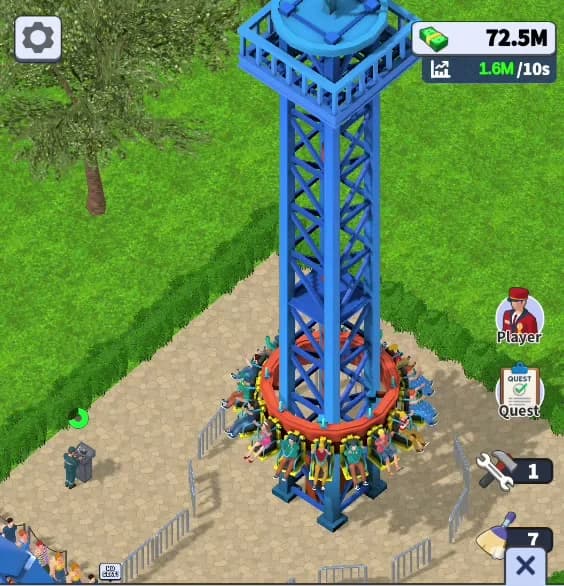
In the park. What players actually meet — one ride among many, read at a fixed distance under the game's camera. The silhouette test the whole request was aimed at.
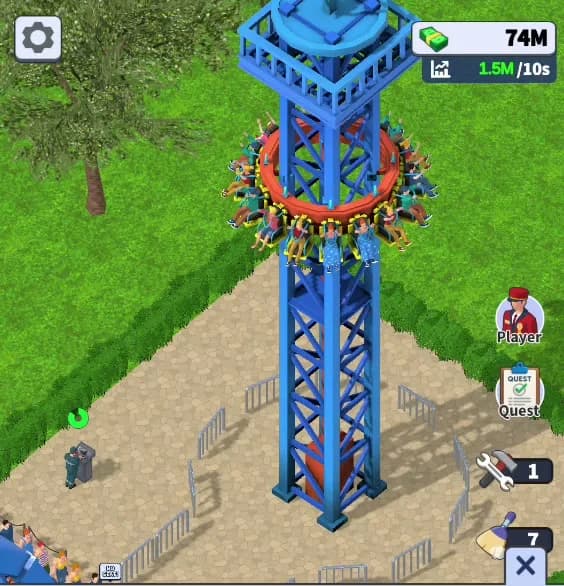
Mid-cycle. A full seat ring climbing the mast — the result of Albus adding animation on top of the asset built with UModeler X.
And then it became a store screenshot
An asset's final exam isn't integration. It's whether the team chooses to sell the game with it.
The Gyro Drop is one of the screenshots on Theme Park Manager's store listing. The ride that came back once in July 2025 and was rebuilt six days later is now part of how the game introduces itself to everyone who meets it for the first time. Same lattice mast, same ring of sixteen seats, riders with both arms up.
Store screenshot courtesy of Albus.
This project changed the tool too
Working with Albus didn't end with the two rides. Feedback from the production itself and from the workshops that followed turned into real improvement items for UModeler X. Among them: an infinite loop during groove selection and the data preservation around it, adding a bone with Shift+drag, the way prefabs are handled, the Crease feature, pivot vertex snapping, and the AI texturing flow.
All of these started as friction that surfaced while building actual game assets. Some were fixed right away; others were reviewed and planned as workflow improvements or new features. By June 2026, a substantial share of the feedback Albus had given was reflected in the product.
So this case shows more than what UModeler X did inside a project. It also shows how feedback from a real production made the tool better. The concrete problems of a team shipping a live game are the most direct input there is for designing the next working environment.
The request
Albus asks for two 16-seat tower rides for a realistic-looking park sim, with photos of real attractions as reference.
First version — realigning the standard
Prefabs built with UModeler X shared with the game team. To match the park's style, Albus provides their existing in-game rides as reference.
The real spec
Seat visibility, under 10K vertices, X-Flyer at 0.7× height, source assets shared. Unity 2022.3.19f1 / URP confirmed.
Second version — aligned to the game look
The rebuilt rides fit the game's look. Substance Painter source files shared the same day.
Running in the build
Albus shares in-game footage: animated, recoloured, loading guests. UV editor feedback goes back to the UModeler X team.
Launched, and scaling
Theme Park Manager launches worldwide. Albus reports the game passing 60,000 downloads a day and still scaling.
Where it ended up
Downloads passed a million on Google Play alone. The climb is steep: 65,533 came in across all stores on a single day, June 6, 2026, and two days later on June 8 the game was still clearing 60,000 a day and rising. Whatever number is printed on this page is already out of date by the time you read it — check the stores for the current figure.
Both store listings show Supercent, Inc. as the seller — Albus is the development studio behind the game.
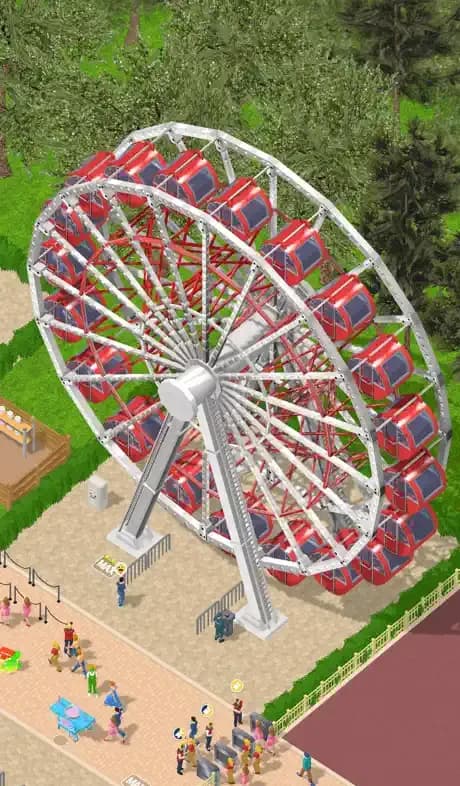
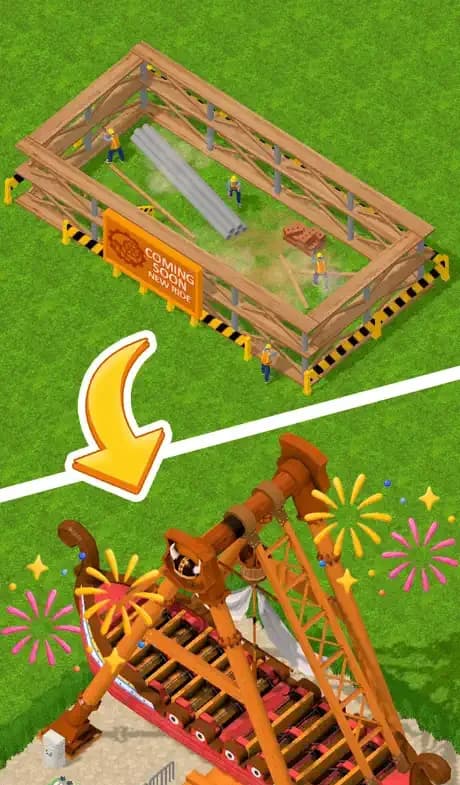
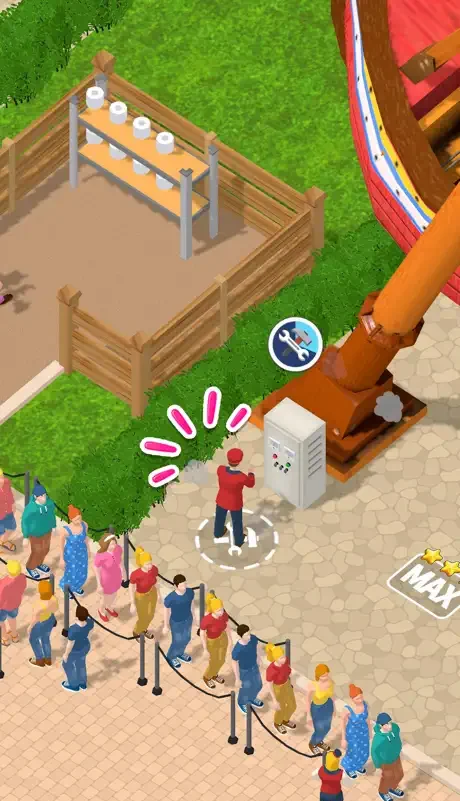
Theme Park Manager in play.
Sources and conditions
Where each figure on this page comes from, and what we did not verify ourselves.
- Timeline and quotes
- Dates (July 23, July 29 and August 19, 2025) and the paraphrased feedback come from the project correspondence between Albus and the UModeler X team.
- Technical spec
- Unity 2022.3.19f1 with URP was confirmed in writing by the studio before the second version. The under-10K-vertex figure is read from UModeler X’s mesh statistics on the delivered prefabs.
- Ride stats
- 16 seats and the 40-second cycle are read from the in-game ride panel shown in the screenshot and clip above.
- Downloads
- The “1M+” tier is Google Play’s own listing figure, re-checked on September 12, 2026. The daily all-store numbers (65,533 on June 6 and 60,000+ on June 8, 2026) were shared by Albus from their analytics and are not independently verifiable by us.
- Video
- The in-game clip was recorded by Albus from the August 19, 2025 development build; what happens at each 4-second mark is listed under the clip.
Review log: September 12, 2026 — sources listed and the Google Play tier re-checked; June 2026 — published.
Frequently Asked Questions
What did UModeler X create for Theme Park Manager?+−
The UModeler X team modeled two 16-seat tower attractions — a Gyro Drop and an X-Flyer. Both were built as editable, Unity-native prefabs that could keep being adjusted inside the project. UModeler X did not build the game itself.
What was realigned after the first version?+−
The game's style language, not the quality. The first version, shared on July 23, 2025, took a playful candy-coloured direction, while Theme Park Manager is a realistic-looking park simulation where the spectacle of a convincing ride is the core appeal. Albus explained the gap against their game's look and provided the rides already placed in their in-game park as reference.
What constraints did the attraction models have to meet?+−
Four: seated guests had to stay visible under the elevated diagonal camera, each model had to stay under 10,000 vertices for mobile, the X-Flyer had to come down to roughly 0.7 times its original height to match the Gyro Drop, and both had to sit alongside the park's existing rides without looking out of place.
What Unity setup was Theme Park Manager built in?+−
Unity 2022.3.19f1 with URP (Universal Render Pipeline). It is the combination used across every project at the studio, and it was confirmed with the game team before rebuilding started so the materials could be authored for that target.
How were the attractions textured?+−
The first pass used a lightweight texture-palette approach, with the option left open to re-unwrap and swap textures if a more photoreal treatment was needed. The rebuilt versions were textured in Substance Painter, and those source files were shared with Albus so the studio could keep tuning the look themselves.
Did UModeler X make the whole game?+−
No. UModeler X's contribution is the asset work on two attractions. Review, ride animation, colour adjustment to the park's palette, integration into the live build, and everything else in the game were handled by Albus.
Did this project feed anything back into UModeler X?+−
Yes. Albus shared the friction they hit in the UV editor while working on the assets, and that feedback went into UModeler X's improvement list. By June 2026 a substantial share of it was reflected in the product, which had also become free in the meantime.
How is UModeler X used in a Unity workflow?+−
UModeler X is a Unity-native tool. Modeling, UV, texturing and revisions all happen without leaving the Unity Editor, inside the very project and render pipeline the assets ship in. Because the asset stays editable rather than baked, a change of direction in the next stage of production is an adjustment rather than a restart.
Explore More
Inside Unity, build assets that fit your game
UModeler X builds, refines and aligns 3D assets to your game's standard — inside the Unity Editor.
Play Theme Park Manager yourself and find the Gyro Drop and X-Flyer built with UModeler X.